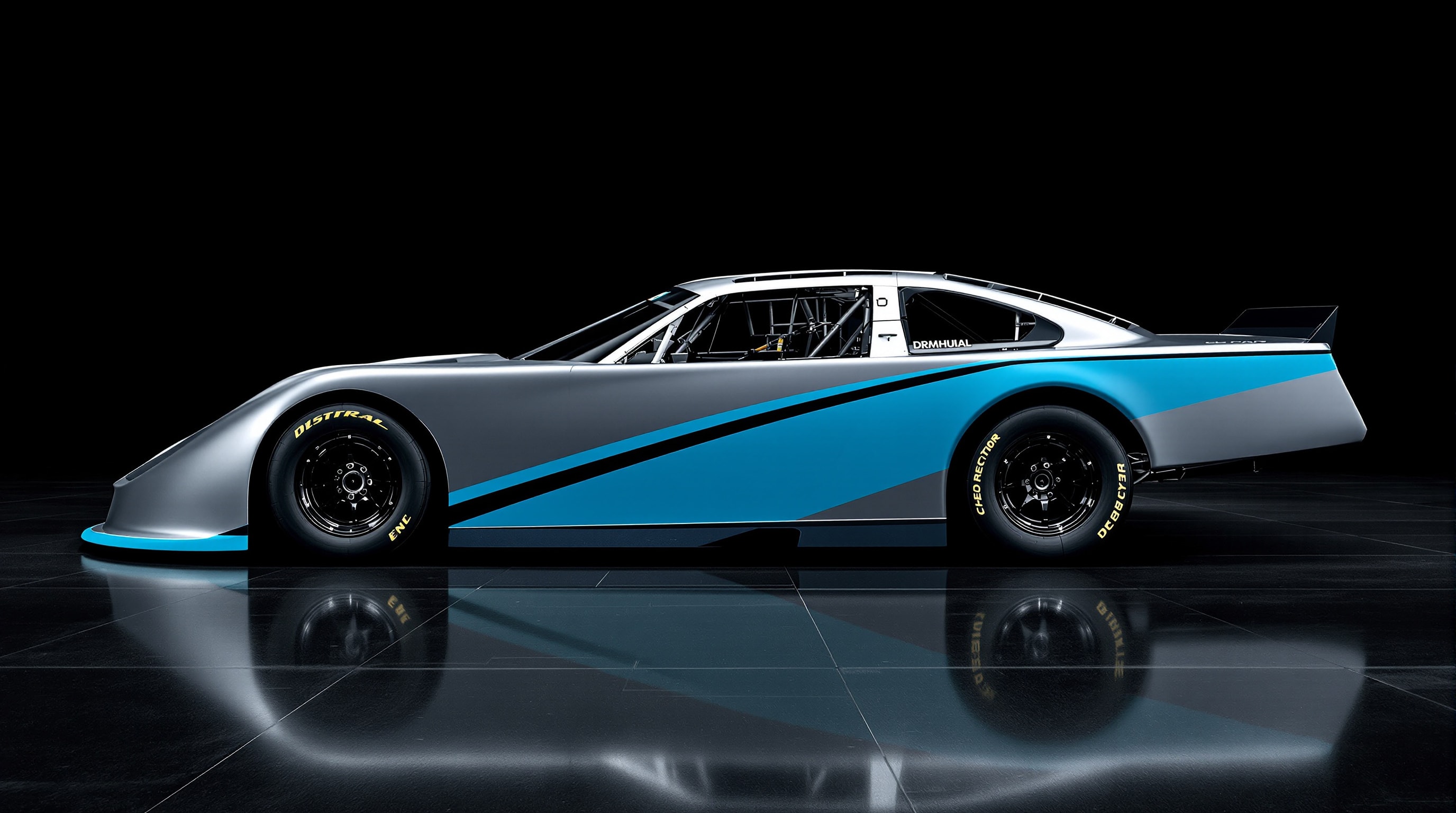
The No. 10
The No. 10 was the team's third entry, added as the operation reached its largest extent. It came into the stable through an alliance with another organisation — a common arrangement at this level and one worth explaining, because it is not obvious from the outside how a small team suddenly acquires a third full car.
How a third car appears
Independent teams grow by combination as often as by construction. A number, a sponsorship programme and sometimes a driver come from one organisation; the shop, the crew and the operational capability come from another; and the entry runs out of a single building. It is neither a merger nor a customer arrangement but something in between, and it is why the ownership of a given entry in this era can be genuinely hard to trace from the outside.
For the operating team the attraction is straightforward. Fixed costs are already committed — the building, the plate, the fabrication bay, the transporter, the machine tools. A third entry spreads those over more revenue. It also means more data: three cars at a circuit is three setup directions in a single practice session, which is a substantial competitive advantage over a single-car operation trying to find the same answer alone.
What it costs
The strain is physical and it lands on the shop. Three cars means three prepared cars every week, three sets of damage repaired between events, and three road crews. Shared personnel start being pulled in three directions at once, and the setup plate — of which there is usually one — becomes a bottleneck.
There is a scale at which an independent team stops being a workshop and has to become a managed organisation, with schedulers and process rather than a crew chief and a whiteboard. Crossing that line is where a lot of teams either professionalise or come apart, and it typically happens right around the third car.
The 2007 section
The No. 10 had the same seven-page section as the other entries — landing page, driver, crew, news, results, show car and autographs. Its dedicated news stream ran alongside those of the other cars, with separate previews and reports for each entry every weekend.
As with the other sections, the individual pages are not republished here; the structure is preserved and the legacy URLs resolve to living pages rather than dying. The reasoning is on the news archive page.
The end of the three-car era
The team was at its largest — multiple full-time entries plus additional cars in selected events — shortly before its second-tier assets were acquired by another owner in late 2010. That is not a coincidence. Growth is expensive, and the point at which an independent operation is most valuable to a buyer is generally also the point at which it is most exposed.
The people and the equipment carried on under the new organisation. The entries kept running the following season. The shop stayed where it was, on the same stretch of road north of Charlotte, doing the same work under a different name — which is, more or less, how the whole industry there has always worked.
Elsewhere
See the team history, the drivers, and the other entries: the No. 32 and the No. 38.