Race Weekend
The original events page was a table — date, circuit, car, driver, starting position, finishing position — refreshed every week as the season moved. What that table compressed into six columns was three days of extremely dense work. This page unpacks it.
Before anyone leaves
The car that goes to the circuit was chosen the previous week, pulled from the fleet on the basis of track type, and prepared from the setup book: springs, bars, dampers, gears, brake package, cooling, ride heights. It is scaled on the plate, measured, and signed off. The transporter is loaded with the primary car, a back-up in the top deck, engines, a wall of spares, tyres, the pit equipment, tools, and the crew's own kit.
The transporter leaves early because it is a long drive, and it is driven by members of the team who will be working on the car when it arrives. Nothing about a mid-field racing operation is glamorous at this stage.
Day one — unload and practice
The car comes off the truck, goes through technical inspection, and gets rolled to the garage stall. Then practice, which is the only chance the team gets to find out whether the week's guesswork was right.
Practice is run as a sequence of deliberate experiments, not as lapping. A short run to check the car is sound. A longer run to see how the tyres fall away. Then changes — one meaningful change at a time, wherever possible, because two changes at once tell you nothing about either. The driver comes in, describes what the car is doing and where, the crew chief decides what to alter, and the clock runs down.
The single most valuable thing that happens on day one is a long run on old tyres. Qualifying pace is a one-lap problem and it is largely decided by the car's trim and the driver's nerve. Race pace is a twenty-lap problem, and a car that is fast for three laps and unusable for the next fifteen will finish a long way down.
Day two — qualifying
Qualifying is a different car. The team trims it out, softens what it can, and sends the driver out to do one or two laps at maximum commitment with cold tyres and a car set up in a way it will never race in.
Track position matters — the pit stalls are allocated by qualifying order, and a good pit stall is worth real time over a race. But an independent team will usually take a compromise here, because a car qualified out of its comfort zone is a car that has spent setup direction it needed for Saturday.
Race day
Final practice, then the car is converted to race trim: fuel load, tyre pressures adjusted for expected track temperature, tape on the grille set for the conditions, cooling checked. The pit stall is set up — fuel cans staged, tyres laid out in the order they will be used, the air lines run, the pit box screens on and the timing feed live.
Then the driver's meeting, the grid, and the start.
Inside the race
From the pit box, a race is an arithmetic problem interrupted by emergencies. The fuel-mileage member of the crew is calculating range continuously and updating an assumption that changes every caution. The crew chief is listening to the driver, watching the timing screens for what rivals are doing on long runs, and deciding when to stop and what to change. The spotter is talking almost continuously — traffic, lapped cars, an incident three corners ahead, the gap behind.
Track position and tyres are the permanent trade-off. Four fresh tyres are the fastest car but the slowest stop. Two tyres, or fuel only, gets the car out ahead of people who took four but leaves it defending on worn rubber. Under caution the calculation compresses to a few seconds and it has to be right, because everyone else is solving the same problem at the same moment.
The stop
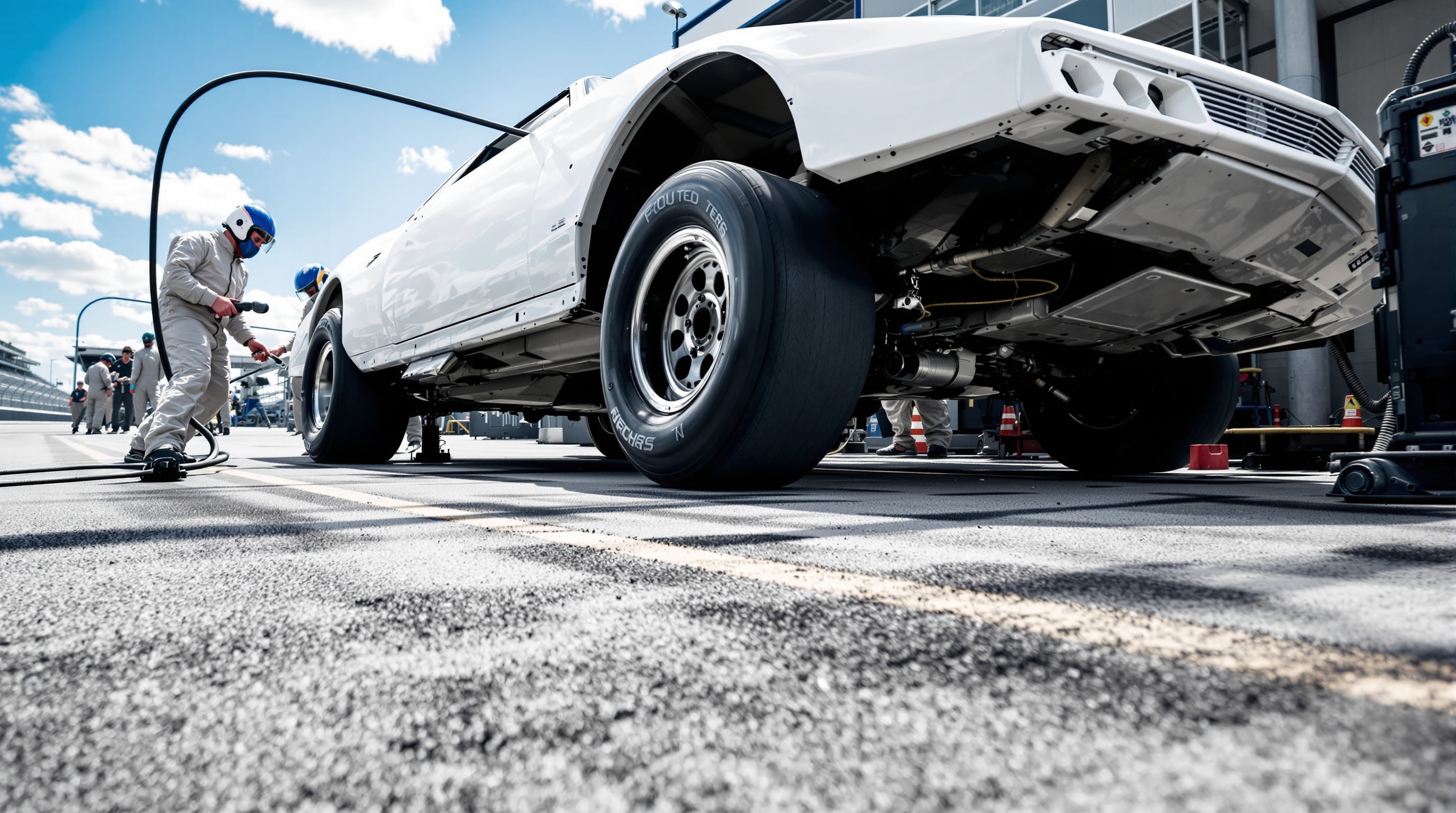
The car arrives at somewhere near walking pace after being at close to two hundred miles an hour a few seconds earlier. The jack goes under, the wheels come off and on, the fuel goes in, adjustments are made — a turn on a track bar, a wedge adjustment through the rear window — and the car leaves. It is over in a handful of seconds and it is rehearsed all week in the shop, because the difference between a good stop and an average one is several positions.
Everything about it is deliberately rehearsed physical choreography: seven people, a fixed sequence, a fixed set of positions, no wasted movement, no talking.
The load-out
When the race ends the crew packs. Tyres, tools, fuel cans, the pit box, and the car — which may be undamaged, may be scuffed, or may be a recovery job. The transporter leaves that night. Most of the crew fly home; the truck drivers do not.
On Monday morning the car goes back on the plate, the damage assessment is written, the notes from the weekend are entered into the setup book, and the process starts again for a circuit that will demand something different. During the height of a season this cycle repeats without a break for weeks at a time, which is why the ten-month schedule that reads as a commercial advantage on a sell sheet reads rather differently to the people executing it.