The Cars
A team at this level did not own a race car. It owned a fleet — typically somewhere between six and a dozen chassis per full-time entry, each built or bought for a category of circuit, plus whatever was in the repair bay at the time.
Why a fleet
Stock cars of this era were purpose-built for track type, because the demands are genuinely different. A car for the big superspeedways is built around drag and stability at sustained high speed. A car for a half-mile short track is built around mechanical grip, brakes and heat rejection. A car for the mile-and-a-half intermediates — which made up most of a season — sits between the two and is where a team spends most of its development effort. Road-course cars are different again, with different brakes, cooling, gearing and, in this era, a different steering setup entirely.
So a team's inventory tended to look like: two or three intermediates in rotation, one or two short-track cars, a superspeedway car, a road-course car, a back-up for the current type, and one or two chassis in various states of rebuild. Each is a serious asset, and losing one on a Saturday afternoon changes what is possible for the next month.
The chassis
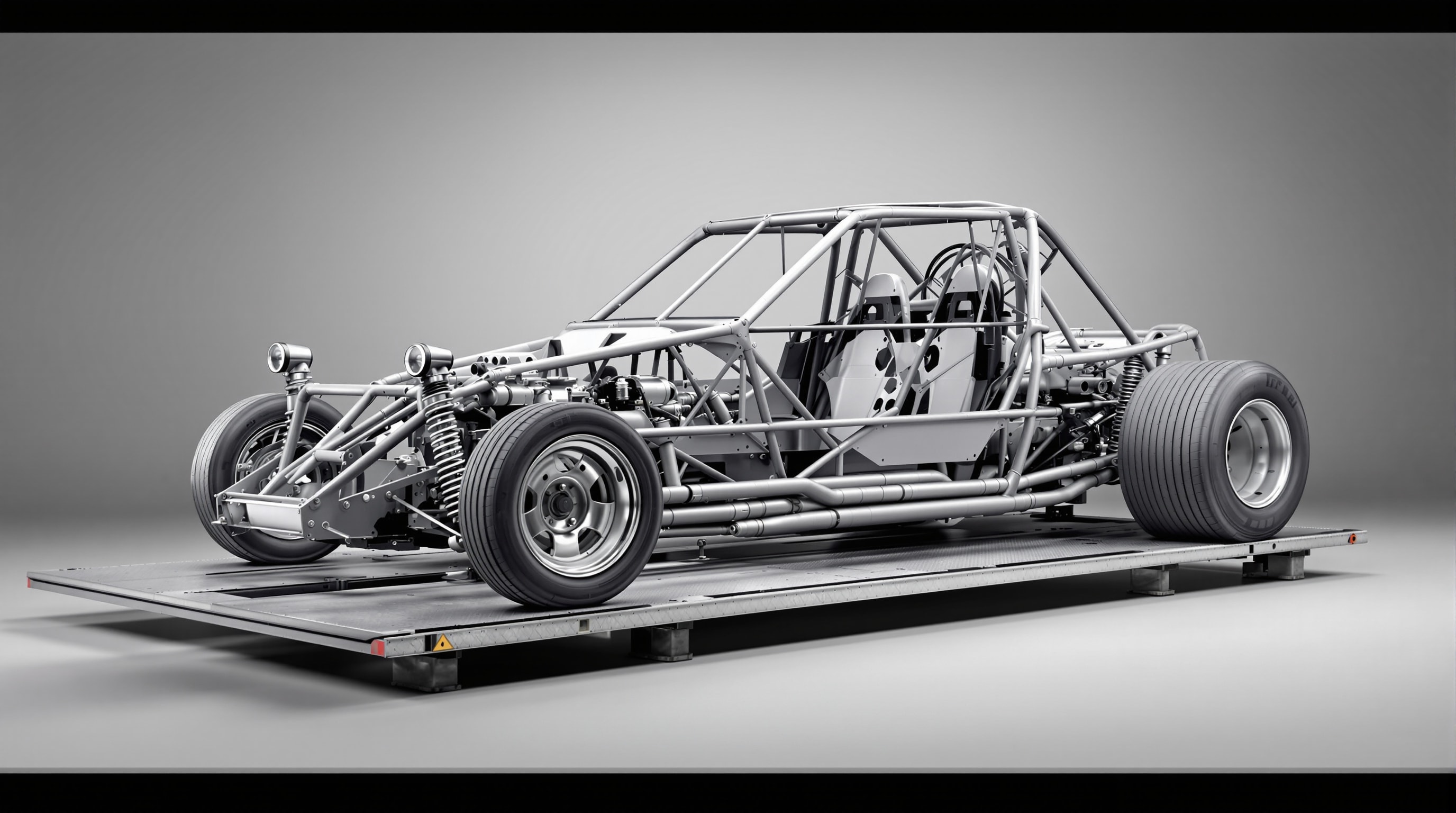
Underneath everything is a welded tubular steel spaceframe. It is not a modified road-car structure despite the "stock" in the name — by the 2000s the relationship to a production vehicle was the silhouette and very little else.
The frame does three jobs at once. It locates the suspension pickup points, which is the entire basis of how the car handles. It provides the safety cell around the driver. And it is stiff enough that the suspension, rather than the structure, is doing the compliance — a frame that flexes makes every setup reading a lie.
Front suspension in this period was double wishbone with coil springs; the rear was a live axle located by trailing arms and a track bar. That live rear axle is the defining characteristic of the American stock car and the reason its setup language is unlike almost anything else in motorsport. Track bar height, in particular, is an adjustment with no clean equivalent in an independent-suspension car, and adjusting it during a race — which teams could do — is one of the few genuine mid-race handling changes available.
Bodywork
The body is hand-formed sheet metal hung on the frame to a template. Fit is checked against gauges, and the tolerances are small enough that the difference between a good body and an average one is measurable on a stopwatch.
Aerodynamically these are crude objects by open-wheel standards and enormously sensitive anyway. Downforce comes from the front air dam and splitter, the rear spoiler, and the pressure distribution over a fairly blunt shape. Ride height changes the front aerodynamic balance dramatically, which is why ride height and spring choice are aerodynamic decisions as much as mechanical ones. Wind-tunnel time is expensive and rationed, which is precisely why manufacturer and top-team alliances mattered so much to an independent.
Engine and drivetrain
A naturally aspirated pushrod V8, carburetted for most of this era, leased or purchased from a specialist builder and typically sealed. Power figures were substantial and, more importantly, similar between competitors — which is exactly why the racing was close and why setup mattered so much.
Between engine and axle: a four-speed manual gearbox with ratios selected per circuit, and a rear-end ratio chosen alongside them. Gearing is one of the few genuinely discrete decisions on a race car — you have a set of ratios in a box, you pick, and you live with it. The calculation balances the rev limit, the length of the straight, corner-exit speed and how much time the engine spends at peak load.
Brakes and cooling
Brake packages vary more than outsiders expect. On a superspeedway the brakes barely work all day. On a flat short track they are among the hardest-worked components on the car, and brake cooling ducting is a serious design problem rather than an afterthought. Rotor material, pad compound, duct sizing and master-cylinder balance are all track-specific choices.
Engine and gearbox cooling is a permanent negotiation with aerodynamics. Every square inch of radiator opening costs drag. Teams tape off as much of the grille as they dare and watch water temperature all race, which is why an early-race caution that lets a car run cool is worth more than it looks.
Inspection between races
A race car is measured after use for the same reason it is measured before use: nothing on it works in isolation. A wheel bearing that develops play can confuse a suspension reading; a bent body mount can change a panel gap; a tired hose or a rubbed wire can turn a small maintenance item into a retirement. Cleaning is therefore part of inspection, not presentation. The dirt has to come off before the fasteners, welds, lines and mounting points can be read properly.
The best record is comparative. Ride heights, corner weights and alignment figures go beside the numbers recorded before the event, while wear on brakes, tyres and driveline parts is considered against the laps and track type. A difference does not automatically mean a failure; it gives the crew a place to look. The same principle applies to the spare car, which must be checked against its own baseline rather than assumed ready because it did not race.
This routine also protects setup knowledge. If a component is changed without being logged, a later improvement may be credited to the wrong adjustment and carried into another chassis. Inspection closes the loop between the car that came home and the one the crew believes it is preparing next.
Safety structure
The safety development of this period was rapid and, in retrospect, overdue. A modern stock car of the era carried a full roll cage integrated into the frame, energy-absorbing door bars, a containment seat that supports the driver's head and shoulders, a six-point harness, a head-and-neck restraint, a fire-suppression system, a fuel cell rather than a tank, and window netting. Circuit-side energy-absorbing barriers arrived across this same period.
Almost all of it is governed by published standards and independent certification rather than by any individual team's judgement. Helmets are certified by non-profits such as the Snell Memorial Foundation; restraint, material and component specifications draw on SAE standards development; and the international governing body maintains its own equipment homologation and safety research programmes, documented at the FIA. A team's job here is compliance and maintenance, not innovation.
What the car pages used to be
On the original site, the cars section was organised by entry and by that entry's primary backer, describing which car ran which programme across a season. That framing belonged to the commercial side of the business rather than the engineering, and it has not been reproduced here — the sponsors were third parties and their marks are theirs. What is preserved instead is the part that was actually the team's: how the things were built.